
Electo.gal estimation for 2024 election - BNG gets nuclear boost, PP may win if PSdG sinks
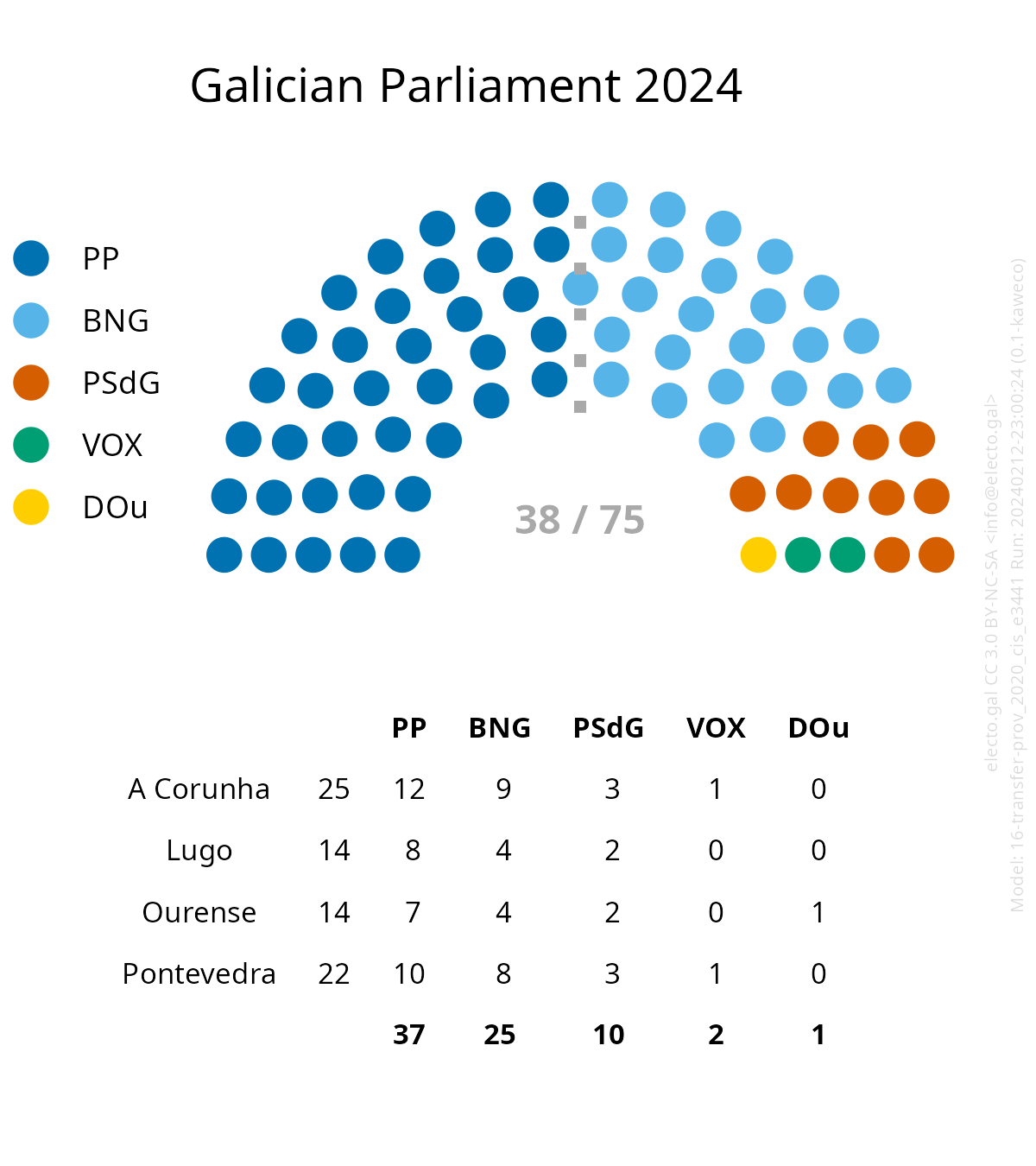
For over half a year we have been following the Galician process looking at the Galician political agenda plausible quantifiable critical junctures and turning points in the electorate. The work articulating our model has helped us to identify some clear outcomes:
-
BNG gets nuclear boost. This election has consolidated Ana Pontón as the political leader of the Galician opposition, with no other candidate retrieving so much preference among those parties. This party shows the highest capacity to retain prior vote, together with PP, but it also gets the highest capacity to retrive votes from supporters of other parties. While still at the left, BNG voters identify themselves closer to the center than in prior elections, getting a position closer to PSdG. An excellent mediatic campaign together with impressive capacities to manage the message and stay out of peripheral positions explains the best result of BNG in their history. Underestimation to BNG is very likely in our raw model because the vote of the past has a very strong weigth so 2-3 more seats would be plausible, opening options for a nationalist presidency independently of the behaviour of other forces.
-
PP resilience. If anything can be emphasized remarked in addition to the remarkable boost of BNG, is the resilience of PP supporters. This campaign has seen a major spillage in the Galician shores which managed to enter the Spanish mediatic debate and reaching the European Parliament, followed by a demonstration of thousands of people from the maritime sector. This was followed by a mass demonstration in favor in defense of the public health system, again joining thousands in the Praza do Obradoiro, the main square of the capital city, Santiago de Compostela. However, support to PP registers only a slightly loss of support. The most recent scandal, questioning ideological coherence of PP with regard to the amnesty, its main battle horse, may feel like a major issue capable to move the conservative electorate. We do not feel so. The weaning trend will continue, may be VOX can be benefitted in some extent, but not to the point of changing seat allocation; at least not with the current information. The effective control of public and private broadcasting media, while incompatible with a normative understanding of democracy, plays a crucial role in preserving a resilience that cannot be underestimated. Our raw model tends to overestimate PP, making 1-2 less seats are plausible, therefore making a PP government fully reliant on other parties.
-
PSdG sinks. The poor performance of PSdG in almost every survey is interesting as well. We found two sources of explanation. The first one has to do with the success of PP to keep alive a polemic about the amnesty to those involved in the Catalan process. Spanish politics matter in Galicia, and it matters the most towards the center-right of the political spectrum. The second source can be found in Galicia. The idea of PSdG succeeding only under the leadership of a nationalist party is working to demotivate their electorate for sure. Added this to moral hazard of the amnesty issue, this works multiplying the magnetic attraction of that modernized BNG. People likes to be in the winner side, and BNG is too close to PSdG as to prevent socialist voters to feel winners.
-
Sumar, Podemos stay out. Several factors can explain why Sumar gets out. First, the most important asset of this party, Spanish Minister of Labor and Social Programs, have been diffuse, to say the most. Announcements from the central Government such as the increase of the minimum wage, and new initiatives such as the reduction of weekly working hours, may have been positively received by the electoral, but hardly transformed into support for the Galician initiative. The polemic in social media regarding the ideological coherence of their coordinator played a negative role in a party whose supporters expressed the highest ideological standards and coherence. The late arrival of Marta Lois, after an accidented process where support of Anova and Podemos was lost, avoided an increasingly good candidate to get the most of its capacities. This applies as well to Podemos representative, Isabel Faraldo. Her intervention in the debate organized by the public television managed to move her from the unknown to becoming a shining voice of the traditional left in Galicia. The faith of Sumar and Podemos exemplify the importance of uniting efforts in such an electoral system. The incapability of VOX to enter the parliament has probably more to do with their lack of understanding of the specificities of Galician political culture, may be a bias induced by their monolitic national-catolicist conceptualization of Spain.
-
DOu, VOX get in. Last, but not least, the more than likely entry of DOu and Vox in the Galician Parliament arrives as the more important innovation of this campaign. Hidden vote among traditional PP voters may explain why this option has arrived so late, and so weak, to surveys. Our raw model is quite conservative, but seats for this parties are quite consistent, so we find this quite likely to happen.
Therefore, our model presents an evolution of the current Parliament where a reinforced strength of BNG may make a nationalist president possible, and with populist and nationalists on the right entering the Parliament and capable to support a PP government if he PSdG sinking trend is confirmed.
Almost a week of electoral campaigning is still ahead of us, and many things may change. During the remaining of this week, we will continue updating the model by monitoring the situation and by asking identified experts about their perceived likelihood of our model. However, the model published today will be the last publicly available one until the vote has been casted on the 18th at 20:00 GMT+1, because law forbids publication of electoral estimations during the last week of the electoral campaign. Only our experts will be able to access our further updates during the last week, and for the solely purpose of model evaluation. We believe that such a ‘radio silence’ on electoral estimations is a healthy practice because social networks and market concentration dynamics are likely to introduce detrimental effects, so we are happy to abide to that requirement.